


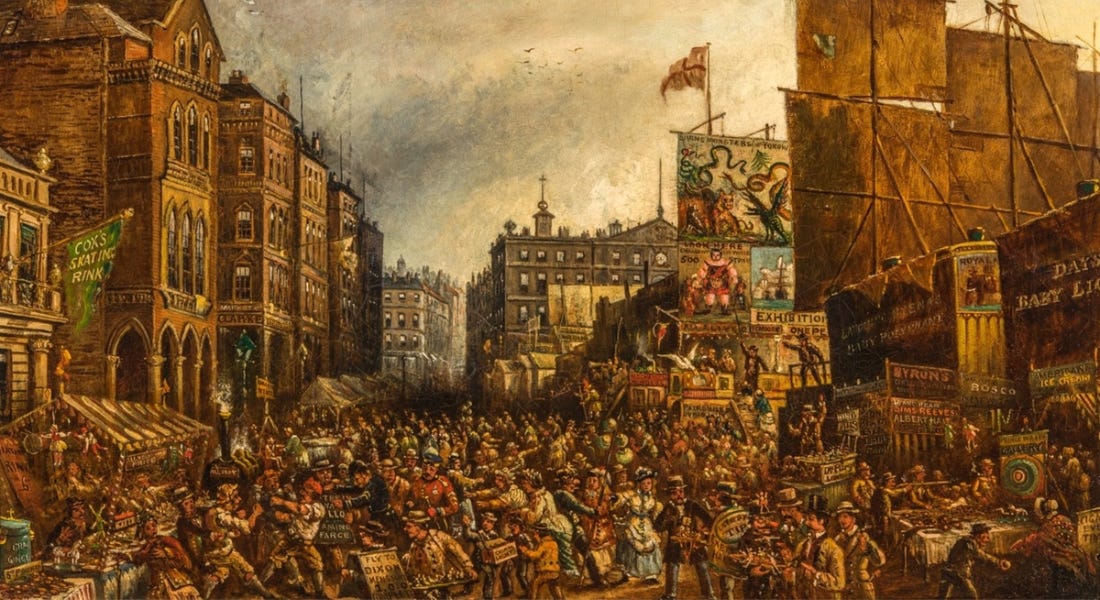
One of the city’s most famous historical incidents is the Nottingham Cheese Riot, which took place during Goose Fair.
We delve into the events that unfolded on October 2 and 3, 1766, including why the riot happened, who was involved, and what they tell us about the past and even the present.
If learning about local history is one of your favourite things to do, read on for this fascinating account. For more features like this, subscribe to The Notts Edit to receive our articles in your inbox for free.
The Nottingham Cheese Riot: The story of the city’s 1766 uprising
By Ashley Carter
It’s hard not to see Nottingham’s Cheese Riot as one of local history’s great punchlines. The image of wheels of cheese careering down cobbled streets, bowling over a befuddled Mayor, could have been lifted straight from a lost Monty Python sketch.
Behind one of Nottingham’s strangest historical anecdotes is a much more sombre reality – a story about hunger, inequality and what can happen when the price of an everyday necessity is pushed beyond the reach of ordinary people. What began with angry crowds seizing cheese from market stalls would end in violence, soldiers in the streets and at least one man dead.
At around 7pm on October 2, 1766, the Goose Fair began to come apart. A group of Lincolnshire merchants had purchased roughly three tonnes of cheese with a view to selling it for profit elsewhere. Disgusted at the prospect, the people of Nottingham answered with a common voice: not a single wheel of cheese should move until the town had been adequately fed. Within hours, cheese was disappearing all over the city, law had effectively broken down and the Nottingham Cheese Riot was in full effect.
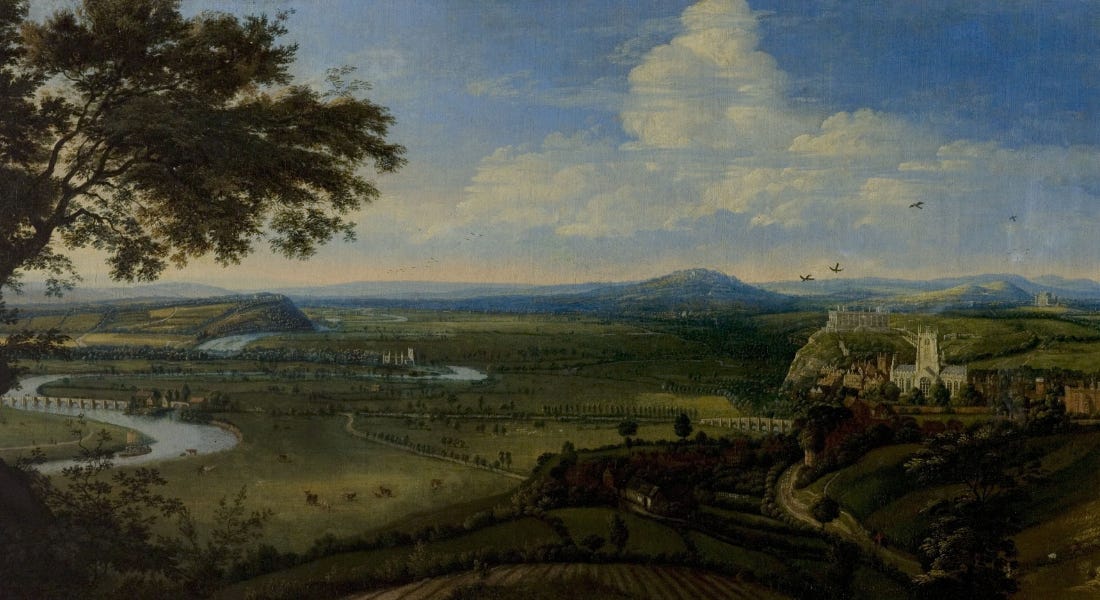
The Nottingham of 1766 was a town in the middle of profound economic upheaval. Its population had grown to around 11,000 people, and manufacturing, particularly the hosiery trade, was expanding. Society had moved past the traditional method of producing your own food, and people increasingly depended on wages and markets for their survival. With the harvests of the mid-1760s particularly poor, those near the bottom of society were faced with a genuine crisis.
The rise in food prices had been dramatic. Wheat, a staple of a typical eighteenth-century diet, was roughly 50-60% more expensive in 1766 than at the beginning of the decade. Someone earning around 1-2 shillings per day (the average labouring wage) could expect to spend about two-thirds of their daily income on a single loaf of bread before rent, fuel, clothing or additional food like meat, or indeed cheese, had even been considered.
Nottingham was far from being alone in facing a crisis, as autumn 1766 saw food disturbances spread across large parts of England. Markets were invaded, carts stopped, warehouses searched, and supplies prevented from leaving towns. In the Midlands particularly, crowds repeatedly intervened in the movement and sale of provisions.
Ostensibly, the Lincolnshire dealers had done nothing particularly extraordinary under the law. They had bought cheese in a market. It belonged to them. They were well within their rights to take it away and sell it elsewhere. But history has no shortage of examples of a desperate, starving population taking an alternative view of how an economy should function. And five words from a contemporary account explain the Cheese Riot better than any image of tumbling wheels of cheddar, as the Lincolnshire merchants were warned not to remove their cheese until ‘the Town was first served.’
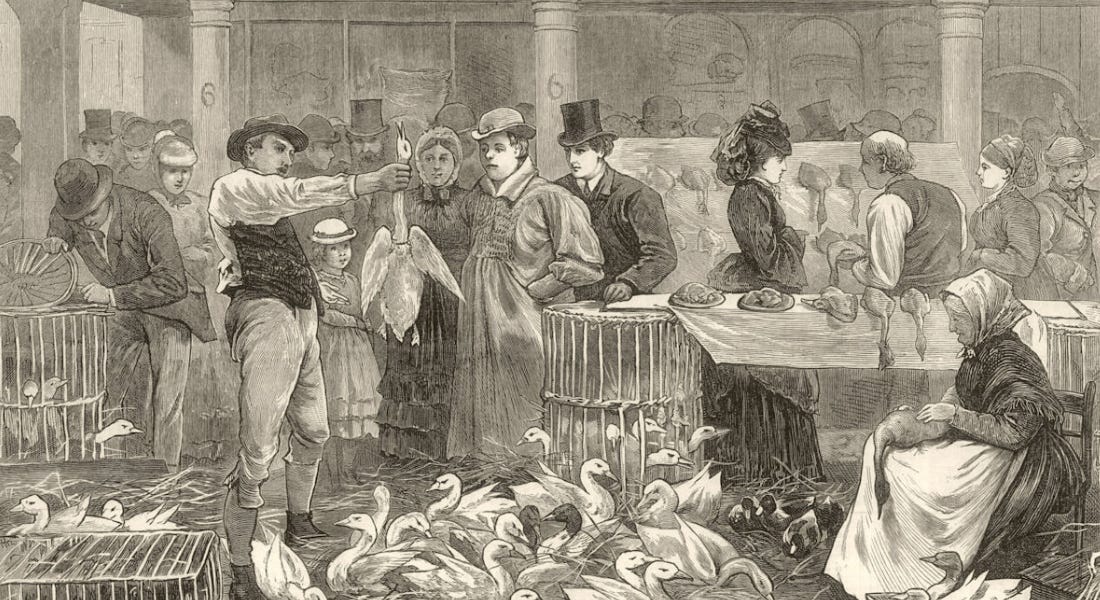
The argument stopped being theoretical as an irate crowd descended on the piles of cheese. Contemporary reporting records that much of it was carried away, particularly by ‘Women and Boys.’ The protesters weren’t stealing the cheese, but insisting that local need should take precedence over commercial freedom. If the people of Nottingham were struggling to afford food, outsiders should not be allowed to sweep into the town, buy provisions in bulk and carry them somewhere else. Other accounts suggest that cheese from commercial factions was specifically targeted, while farmers selling their own produce were largely left alone.
Large cheeses were rolled through the streets, particularly around Wheeler Gate and Peck Lane. A later Nottingham chronicle supplied the detail that has made the riot immortal: Mayor Robie Swann, attempting to restore order, was supposedly knocked off his feet by a wayward cheese wheel.
As magnificent as this incident seems, the first mention of the Mayor vs. Cheese showdown comes over a century after the events themselves. It may preserve genuine local memory – it may be, as all great stories are, improved and distorted over the years of re-telling. Either way, Swann had bigger problems than dodging cheese wheels.
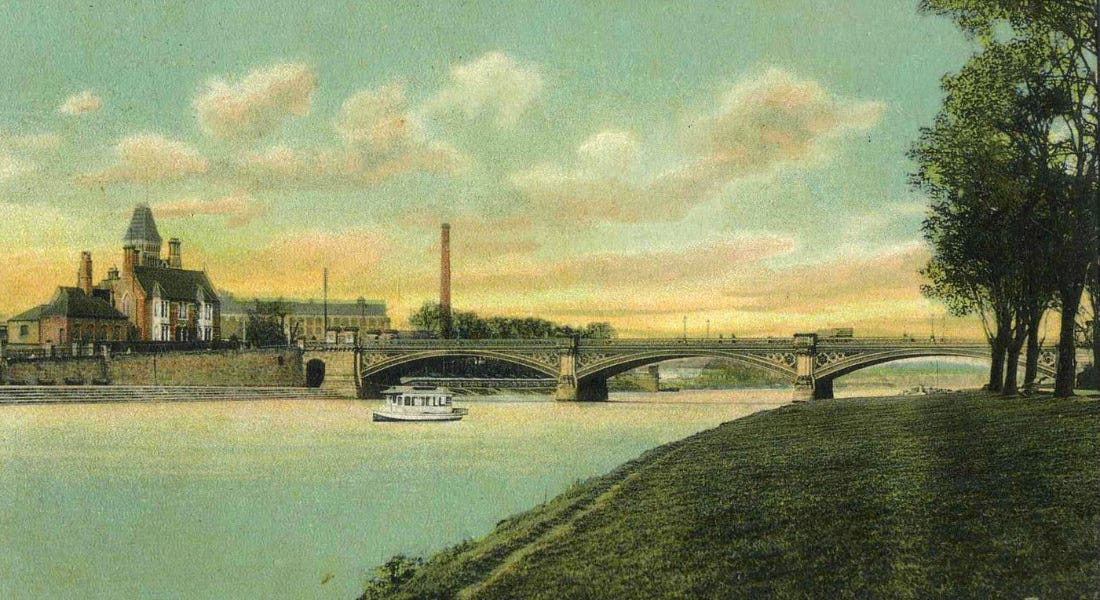
As part of the crowd moved towards Trent Bridge searching warehouses for more cheese, others were arrested and taken before magistrates examining prisoners at a coffee house in Peck Lane. Hearing of the imprisonment of their fellow rioters, crowds surrounded the building, smashed its windows and screamed threats against those responsible. Faced with the very real threat of further violence, the authorities released the prisoners. For a few hours, Nottingham’s civic government had effectively lost control of its own streets.
Law and order looked very different in eighteenth-century Britain. Without a modern police force to summon, public order depended on constables, magistrates, and a social contract between the authorities and ordinary citizens to maintain peace. As soon as that system broke down, the only card left to play was military intervention.
At around 11pm, a rider was hastily sent to Derby with a simple but direct message: send soldiers. By 6am on October 3, forty light dragoons, armed with their traditional Carbine muskets, pistols and sabres, arrived under the command of Lieutenant Bain. After initially restoring something of an uneasy calm, the city once again descended into chaos by nightfall.
At 7pm, almost exactly twenty-four hours after the first seizure of cheese, another crowd formed around the Market Place. What began as a protest descended into violence as soldiers began to open fire on the crowd, who fired back in turn, injuring several people.
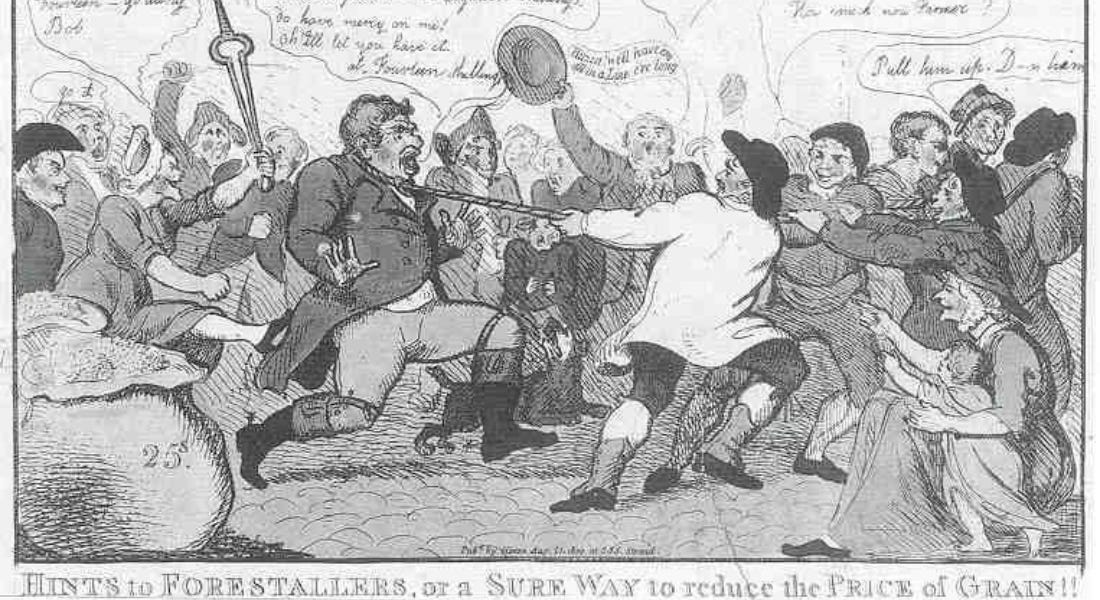
Among them was a farmer from Car Colston named William Eggleston, whose name will forever be responsible for elevating the Cheese Riot beyond a curious footnote in Nottingham history. The Nottingham Corporation’s accounts reveal his fate with grim simplicity. First, money was spent on treating the gunshot wound in Eggleston’s leg. Later, they recorded a further expense for his coffin.
Meanwhile, the struggle over food continued. Crowds again moved towards Trent Bridge, intercepting a boat carrying cheese. Disturbances continued in and around the town for several days – the dragoons continued in their attempts to impose order, and the authorities read the Riot Act, forbidding the gathering of twelve or more people, the punishment for which could mean death. Across the wider region, similar attempts were made to prevent provisions from being removed, and the River Trent itself had become part of the battleground.
Eighteenth-century Britain saw food travel through networks of fairs, carts, warehouses, roads and navigable rivers, and those who controlled those routes held enormous power over where provisions went and what prices they might command. The rioters tried to interrupt that system, exhibiting behaviour E.P. Thompson would later describe as the “moral economy” of the eighteenth-century crowd.
Historian Thompson argued that food riots were often not simply explosions of hunger or criminality, and that ordinary people carried with them ideas about how markets were supposed to behave. Profit was accepted as a natural part of the process, but profiteering in a crisis was not. Property mattered, but so did the obligation to feed a community. Traders could sell food, but hoarding it or removing it during scarcity could be regarded as an abuse of economic power.
Perhaps the most revealing detail is the prominent role of women in the riot. Eighteenth-century politics was overwhelmingly male – women could not vote in parliamentary elections and had little direct influence over government. Yet food provisioning was frequently part of women’s everyday responsibility within the household. When prices rose and children needed food, supposedly private domestic responsibilities could turn into public political action. When a newspaper reported that the Nottingham cheese was carried away chiefly by ‘Women and Boys,’ it inadvertently recorded a group largely excluded from conventional politics asserting itself through activism.
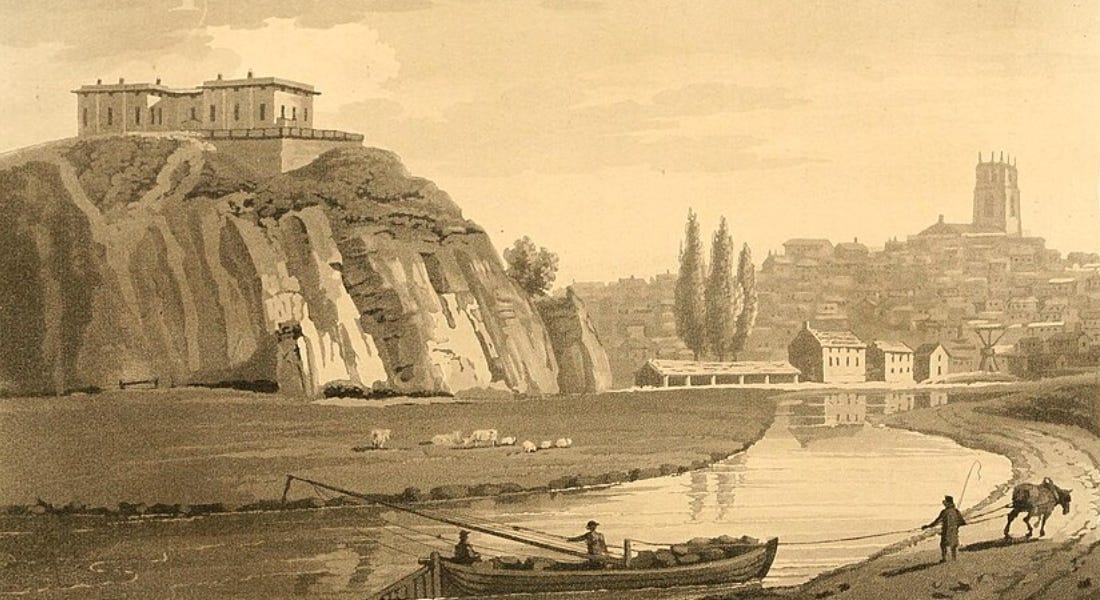
The riot also belongs to a larger Nottingham story. Over the following decades, the town would become increasingly industrial and repeatedly turbulent. Framework knitters fought over wages and working practices. Luddism spread through Nottinghamshire. In 1831, during the struggle for parliamentary reform, rioters would burn Nottingham Castle. In a small but telling event, when the revolutionary Napoleon Bonaparte was defeated for the final time at Waterloo, almost every city in England exploded in national celebration. Nottingham fired a solitary cannon to mark the event.
No straight line connects a woman carrying away a cheese in 1766 with a Luddite breaking a stocking frame fifty years later. The causes were different and so were the people involved. But the method and spirit are recognisable. When established authorities proved unwilling or unable to address economic grievances, Nottingham crowds repeatedly discovered that assembling in sufficient numbers gave them a political power they lacked individually.
That is what makes the Cheese Riot much more than an isolated, peculiar part of the city’s past. The image of runaway cheeses is why the story has survived, but the rioters were protesting something much bigger.
Who has the first claim on food during a crisis? Does ownership give someone the right to remove an essential commodity from a community that needs it? At what point does profit become profiteering? What obligations do governments have when the market price of necessities puts them beyond the reach of ordinary people?
The language has changed, but the argument has not entirely disappeared.
In October 1766, Nottingham’s answer was delivered with remarkable clarity: the cheese could leave, but only after the town was served.
🤳 Keep up with us on socials on Instagram and TikTok
✉️ Send stories such as press releases and feature ideas to editor@thenottsedit.com
💰 Want to feature your business in The Notts Edit? Email Eve Smallman at editor@thenottsedit.com to receive our media pack
☕ Enjoying The Notts Edit? Buy us a coffee on Ko-Fi and help fuel our words