


Bonington Gallery has hosted some excellent work recently – and its latest exhibition, Common Grounds: Counterculture & Confrontation Since 1976 – is no exception.
We spoke with photographer Alan Lodge about the event that captures his 50 years of photography, from facing off against the police to shining a light on communities and movements that were – and still are – misrepresented.
If you’re looking for autumn events in Nottingham, this is on from September 25-December 12 (free entry, boningtongallery.co.uk). For more features like this, subscribe to The Notts Edit to receive our articles in your inbox for free.
Alan Lodge has been capturing counterculture and confrontation for over 50 years
By Eve Smallman
Photos by Alan Lodge
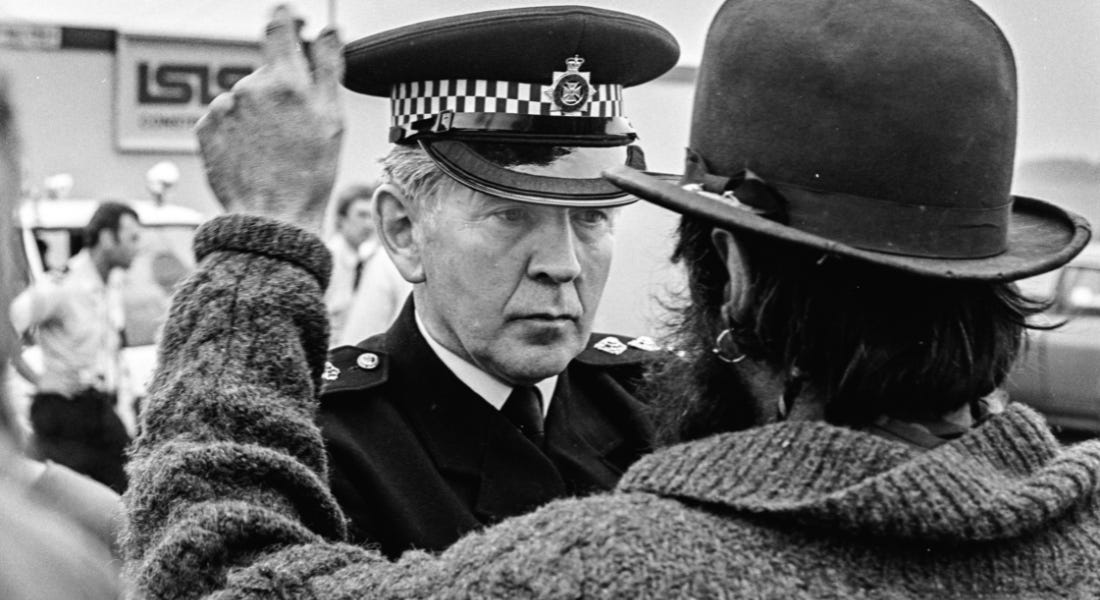
There’s one thing being a photographer who captures events. A snapshot here. A close-up there. But it’s another thing entirely immersing yourself in the events, the happenings. Getting to know the people, the places, the causes. And sometimes that even means turning the camera to the faces and to the actions of those who don’t want it capturing.
Alan Lodge has been doing just that for 50 years.
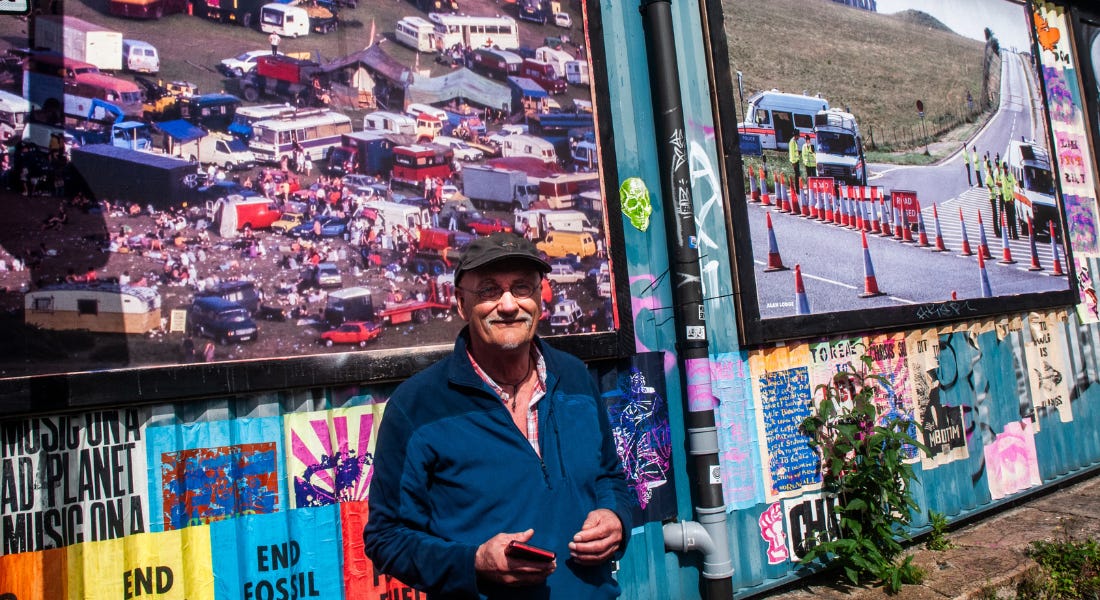
‘The very first time was when I was about 14 in a school darkroom under the stage, and I think I vaguely remember having an interest for a few months – but then that evaporated with other interests of a teenage kid,’ says Alan. After leaving school in 1972, he went to a few free festivals, and was enamoured by the people there. ‘We just wanted to hang out, but policing was quite central to all of this because of how we were committing offences, probably minor offences, probably interfering with trespassing with Windsor Great Park – we were in the Queen’s back garden, for example.’
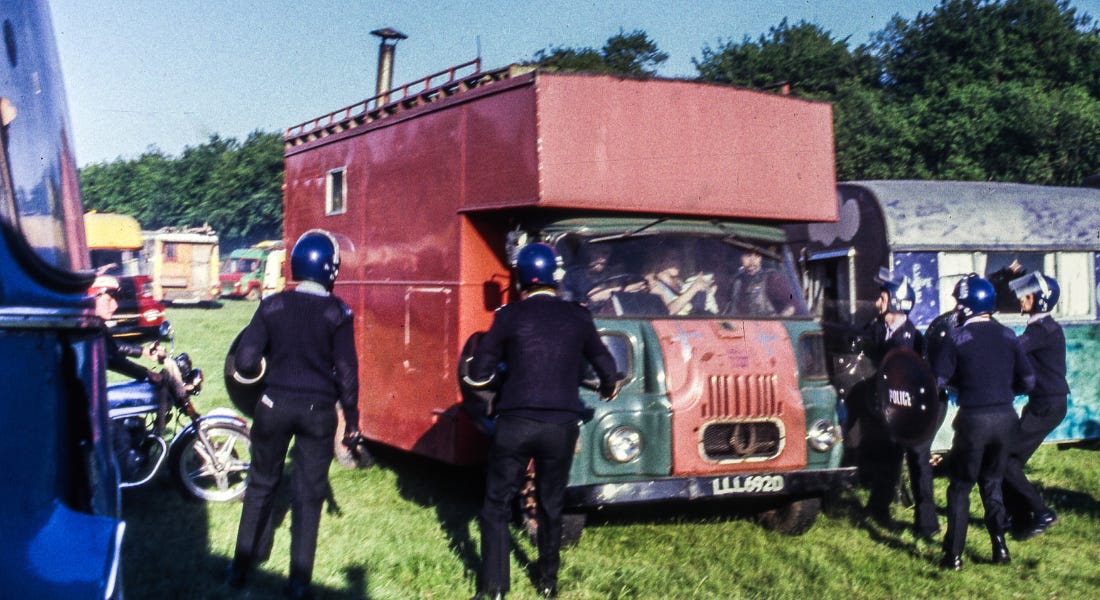
With policemen being so front and centre in this lifestyle, he started to photograph their operations. ‘Very often they exceeded the law or the powers that they had, and I think it was necessary to get some evidence of this from the late 70s to the early 90s, when they started to apply the screws to this community – I started to photograph their operations, and they didn’t like it one bit.’
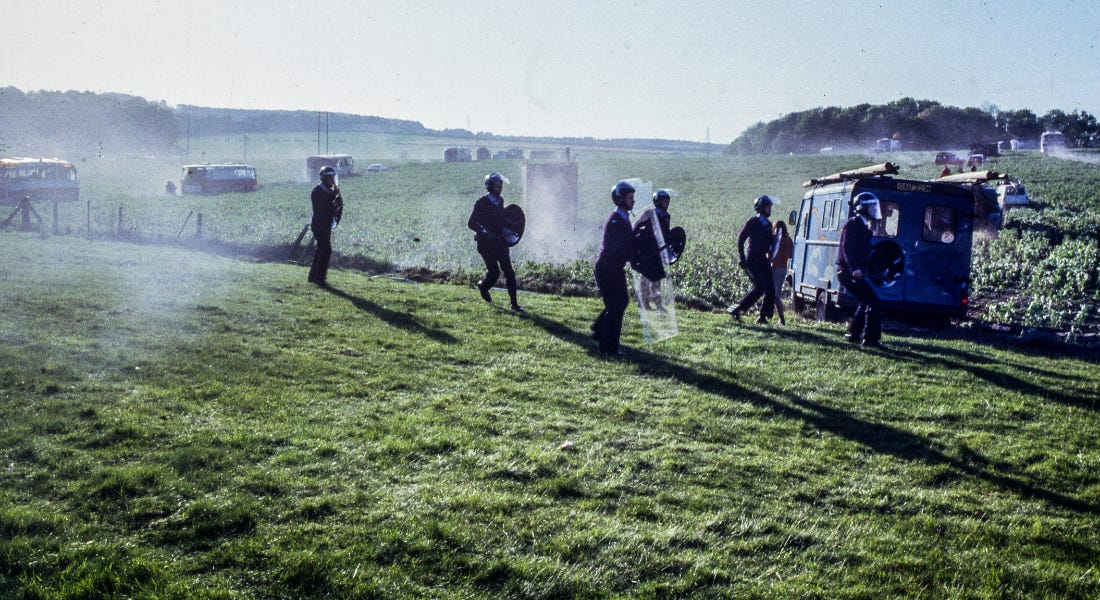
While doing this, he’d look over his shoulder and see interesting bunches of people. ‘Nobody else was doing this apart from the mainstream press, who had a bit of a downer on these groups – and so I started to be a bit more positive in my representation.’
For Alan, this was important to do – as he says, ‘If not you, who?’ He continues, ‘The thing about history I’ve discovered over these years is that winners write history – somebody wins, and they write an account of how great they are,’ he explains. ‘If you read a newspaper, the media, listen to the police now, what the government says about alternative groups and so on… they have crushed us in the field and have put their narrative on what happened.’
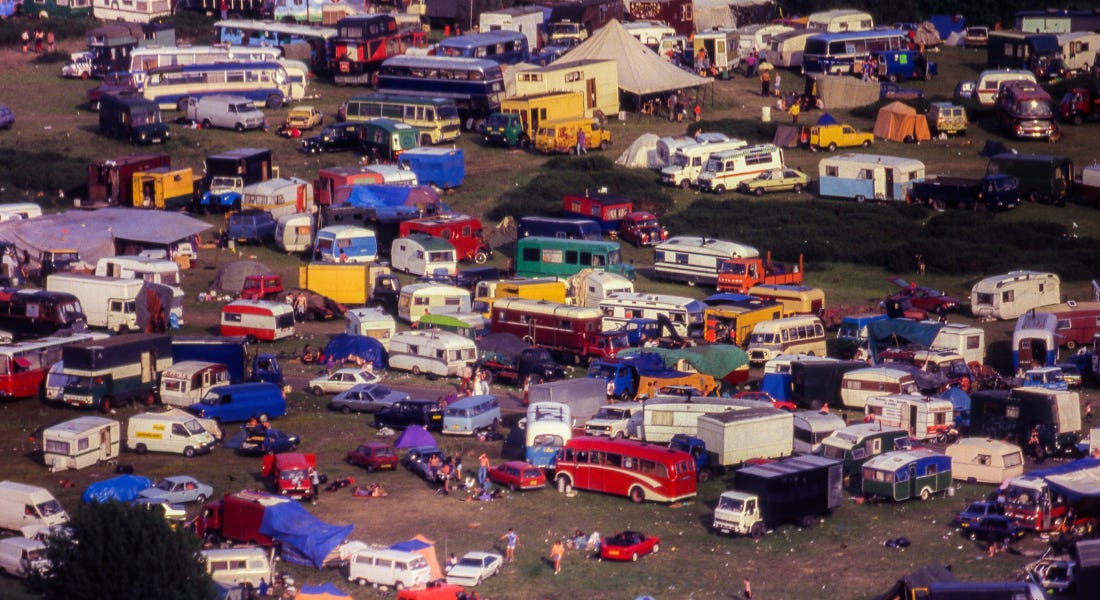
He began by, along with others, forming the charities Festival Welfare Services and the Travellers Aid Trust, which maintained a presence at festivals and travelling communities. ‘The free festival scene collapsed because of police oppression, which then developed into the free party and waves and rave scene – but of course that was combated by the police and the Criminal Justice and Public Order Act, which said that you don’t just need to be a traveller anymore to commit an offence,’ Alan explains. ‘If 20 people bring with them 12 vehicles to a place and if 20 people listen to music that is characterised by a succession of repetitive beats, that’s it… and so the law continues to twist on it.’
The change in narrative is what happened to the first of his communities. ‘They crashed us in the field and changed the narrative to how that happened and whose fault it was,’ he says. ‘I’ve read a newspaper description of that festival while I sat on my log drinking a cup of tea – my eyes have gazed up, looked from left to right, and I’ve compared what I see with what I see in the paper, and there is no correlation at all.’
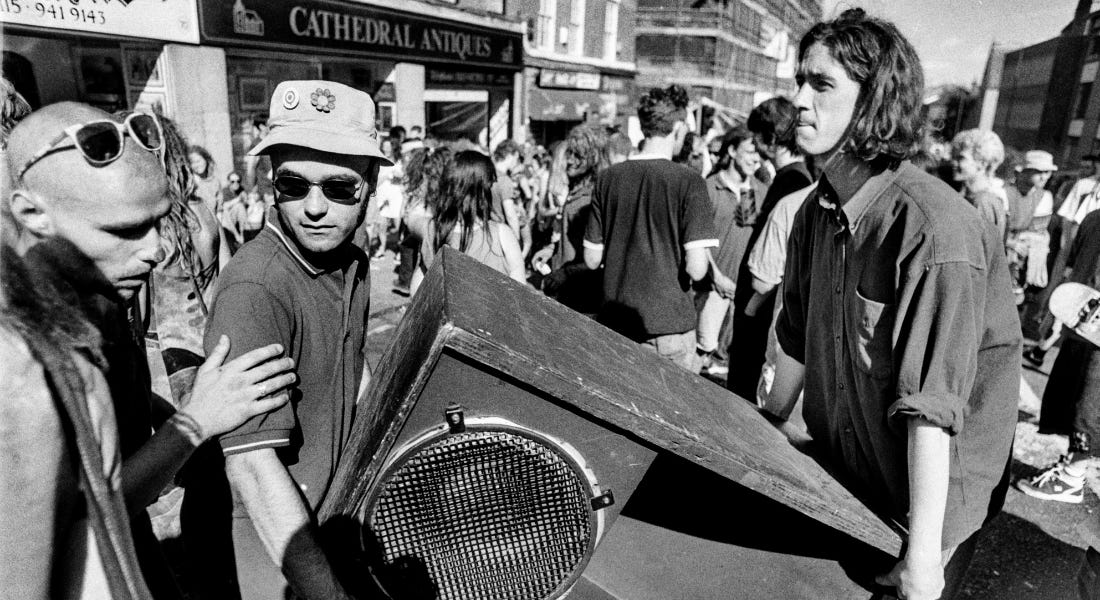
As Alan says, unless you’re present at an event, you have to rely on some journalism. ‘I wanted to try and make a mark in this with the accuracy of the representation that was documenting us,’ he explains. ‘Some of those old newspaper headlines, which will be displayed in the exhibition, are in my mind, but they’re not in the public’s anymore because they’re 40 years ago – they’re the chip wrappers that have evaporated, aren’t they?’ He hopes that some of his work survives history, and that it revises that view of history and that record of history that the ‘winners’ have made.
‘In the 50 years that I’ve done this, there are other photographers that I look up to, and I think they’ve covered that aspect of things so much better than me – I look up to them, I wish them well, and I’ll try and learn from them,’ Alan says. ‘But there aren’t any that – well, I can’t think of anyone else – that started in 1976 and carried on to last week on the themes that I see connected between each other.’ This is his ‘claim to fame’, if you like. ‘Not because of my excellence, but because of my staunchness and keeping up with it.’
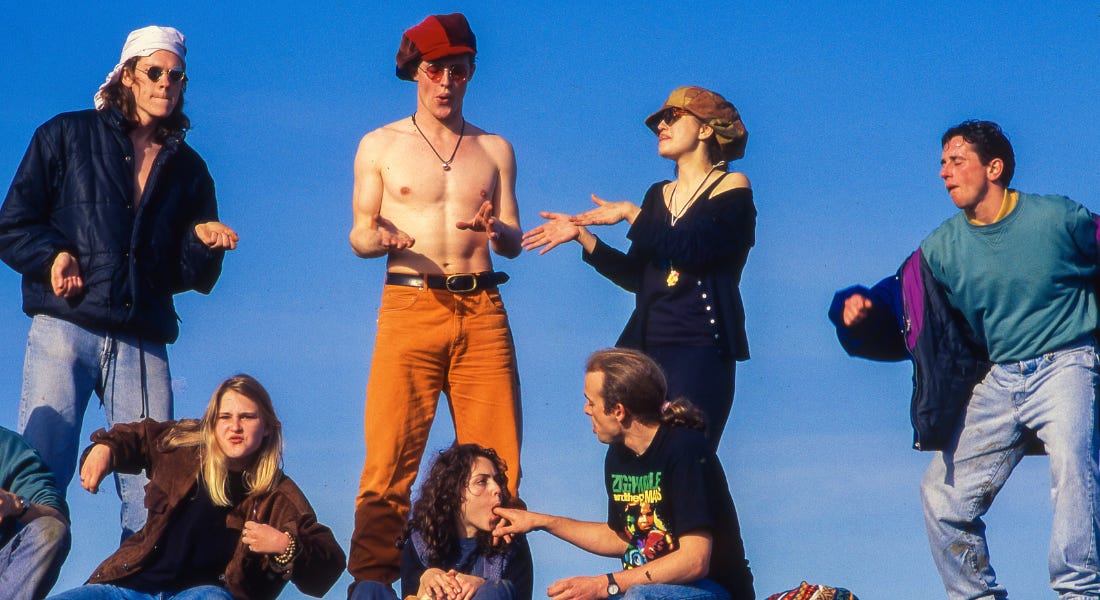
Alan is quite modest in saying this. Looking at his photos, you can see the colour, the passion, the raw emotion from people, captured with intention – not by chance. One of these is the ravers having it large at Castlemorton from 1992, which Alan named as his best photograph in The Guardian. ‘There’s a bunch of ravers on top of a truck, including a couple in the foreground where I could see as I was photographing the scene that they were clearly into each other,’ Alan explains.
‘They liked each other a lot, kissing and cuddling and things while all this was going on around them – and then the man produces his index finger and shoved it in the face of this lass.’ What was on the end of that? ‘I would suspect it to be MDMA – it’s an intimate motion,’ he continues. ‘Lots of people have commented about it to me that it’s not just the drug in the centre – it’s the expression and countenance of those around him, around them, that’s so recognisable to so many people, of the attitude that they say they go to those sort of parties for.’
For Alan, it’s a great shot. ‘It reaches the people that I had photographed, who, by the hundreds, have told me this encapsulates the scene and why I’m in it,’ he says. ‘I’m honoured by that feedback – that they got what I was trying to say, and they agree.’
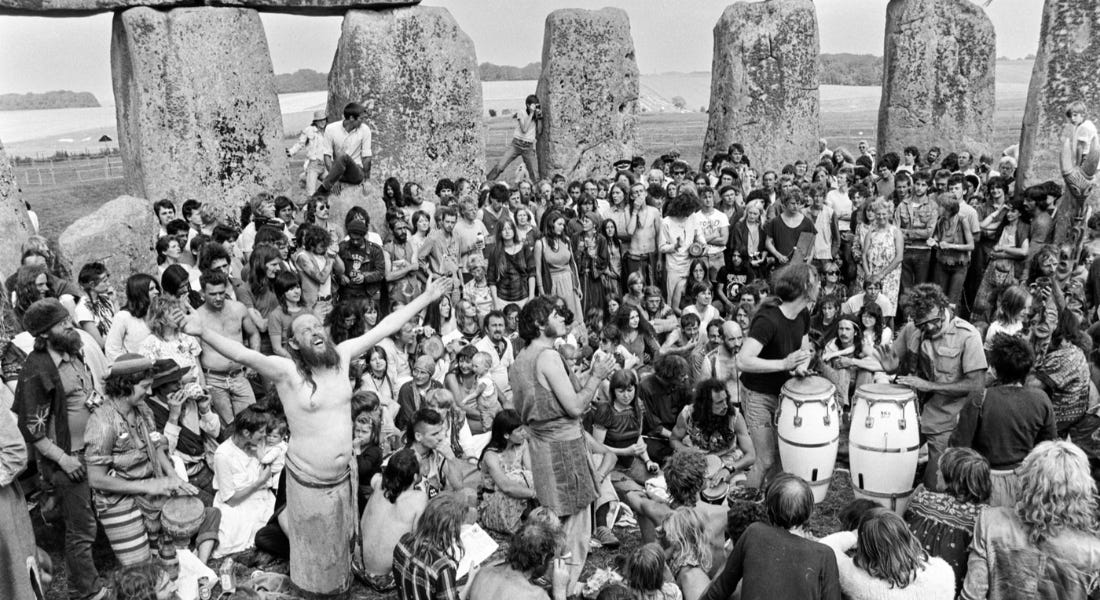
However, what’s his actual favourite? ‘I rather admire a picture at Stonehenge I took of a chap called Sid Rawle who was described by the media at the time as king of the hippies – which, for a bunch of anarchists, is a bit unusual, isn’t it?’ Alan explains. ‘But there’s a gathering in Stonehenge that I took a picture of in 1984, and Sid has got his arms outstretched, and I believe he’s saying something like, “Behold, O sun”, or something like that, as the sun rises.’ It’s a little bit of showmanship. ‘You look out the corner of your face and you see the sun’s about to rise, and then you do something mystical, don’t you? I’m rather pleased with that picture.’
If you’re wondering what to expect from the exhibition, you can expect an enormous amount of striking work. I walked around before it opened and was struck by the sheer vastness. ‘Because of the volume of the exhibition, we’ve had trouble with the title to try and encapsulate the work within the title [Common Grounds: Counterculture & Confrontation since 1976] – but the work does stretch well beyond the title,’ Alan says.
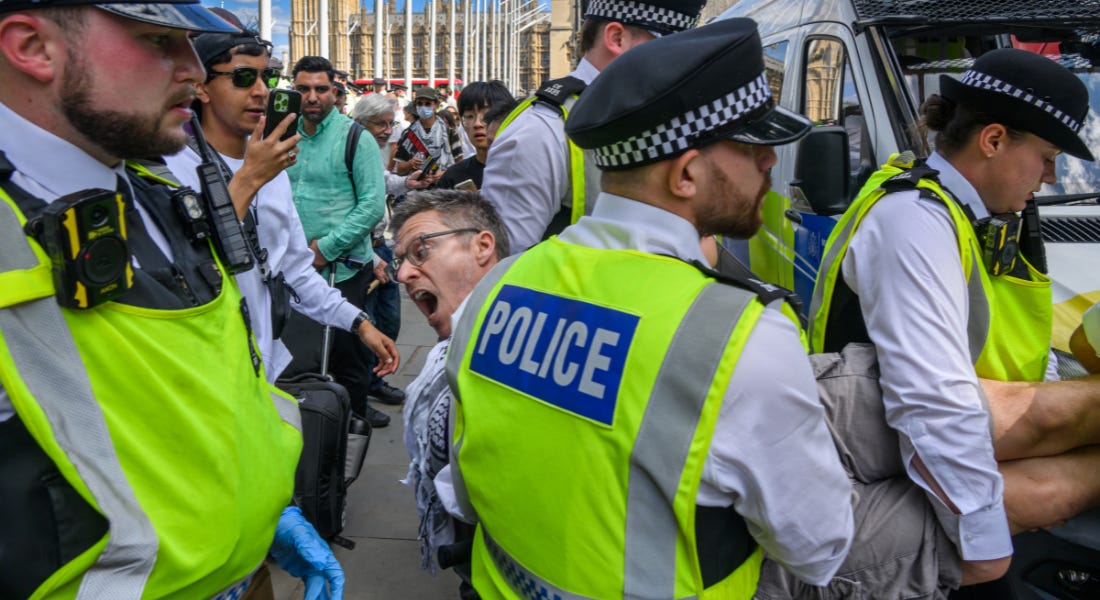
He continues, ‘I don’t want to be regarded as this historical curio, the chap that took all those pictures years ago – I was working right up to last weekend and I want people to know that.’ In Nottingham, he has covered multicultural events, protests, happenings in Old Market Square, and even just individual aspects of city life.
‘It’s predominantly police activism – those communities that I’ve been describing are the main thrust of the exhibition – but because I carried on into Reclaim the Streets, environmental protest unions, workers’ rights of different sorts, all of those things seem to have some kind of relationship with each other,’ Alan says.
There’s also an interview that Alan conducted that goes round in a 48-minute loop to explain all the background. ‘I’m famous for doing a slideshow at events to show the work back to people – by doing a slideshow, both in clubs, at free parties and festivals, I was able to show people what I photographed – so there’s going to be an installation of slideshow transparencies on one of the boards as well.’
As well as this, there will be two film showings – Operation Solstice and Free Party: A Folk History – both of which reinforce the contents of the exhibition and give an idea of the entirety of what it’s trying to explain. ‘It will be quite multimedia and multifaceted,’ Alan adds.
I ask why Alan thinks people should go and see it. ‘Because it’s bloody excellent,’ he laughs. ‘It’s in a university setting, and I’m grateful for the university setting because it does seem as though a lot of young folks at university engage in a lot of these activities and have done for the last 50 years,’ Alan continues. ‘The alternative culture is something that has informed mainstream culture in the shape of music, style, fashion – and I think people need to know that, especially for the students that are studying a variety of courses to do with social matters, to see that society doesn’t have to be organized as it currently is. There are other possibilities.’
Alan doesn’t claim the exhibition provides answers – it just aims to unlock thoughts within people. ‘If you’re a student, if you’re staff, if you’re learning anything, or you are inquiring, then I say that you need to see exhibitions that show not just mainstream or arts that you understand, but things that you don’t necessarily understand or have been misled about in the past,’ he finishes by saying. ‘So if you’re interested in keeping yourself informed… Go and have a look.’
Common Grounds: Counterculture & Confrontation since 1976 is on at Bonington Gallery from September 25-December 12 (free entry, boningtongallery.co.uk).
🤳 Keep up with us on socials on Instagram and TikTok
✉️ Send stories such as press releases and feature ideas to editor@thenottsedit.com
💰 Want to feature your business in The Notts Edit? Email Eve Smallman at editor@thenottsedit.com to receive our media pack
☕ Enjoying The Notts Edit? Buy us a coffee on Ko-Fi and help fuel our words